Musk Open Sources X Recommendation Algorithm: A Complete Overhaul from Manual Features to Grok Transformer
An in-depth analysis of the open-sourced X (formerly Twitter) recommendation algorithm, exploring its zero manual feature engineering architecture based on Grok Transformer, and the implications of this transparency revolution.
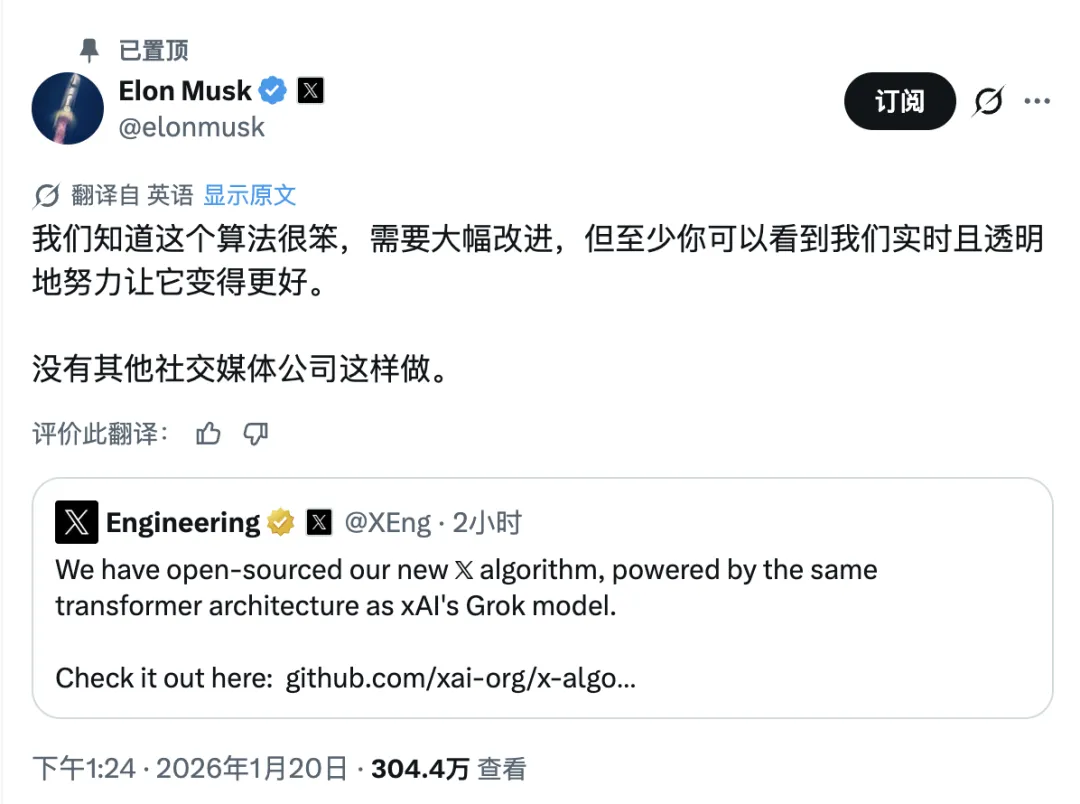
The black box of social media has finally been cracked open. Elon Musk has officially fulfilled his promise by open-sourcing the recommendation algorithm code for X (formerly Twitter). This is not just a seismic event in the tech world, but a milestone in the history of social media. The X engineering team (@XEng) has confirmed that the new algorithm has undergone a complete underlying refactor, fully adopting the same Transformer architecture as xAI’s Grok model and completely abandoning traditional manual feature engineering.
This move marks X as the first major social platform to make its core traffic distribution logic completely transparent. As Musk stated, “We know this algorithm is dumb and needs a lot of improvement, but at least you can see us trying to make it better in real-time and transparently.”
Key Takeaways
- Full Open Source: X officially releases its recommendation algorithm code, making core logic transparent.
- Architectural Overhaul: A shift to a Grok-based Transformer model, achieving “Zero Manual Feature Engineering.”
- Two-Stage Process: The system consists of two core stages: “Candidate Generation” (Thunder/Phoenix Retrieval) and “Scoring” (Phoenix Scorer).
- Public Weights: The specific calculation formulas and weights for user actions (likes, retweets, blocks) are revealed.
- Continuous Iteration: A commitment to update the code every four weeks and optimize based on community feedback.
1. Farewell to Manual Features: A Paradigm Shift in Recommendation Systems
Traditional recommendation systems often rely heavily on manually written rules and heuristic algorithms. Engineers would subjectively define what constitutes “good content” and assign weights to different features. However, X’s new algorithm radically breaks this tradition.
1.1 Zero Manual Feature Engineering
According to the open-source documentation, the core design decision of the new system is “Zero Manual Feature Engineering.” This means the system no longer depends on rules subjectively defined by engineers but relies entirely on the Grok-based Transformer model.
- Data-Driven: The model automatically judges content relevance by learning from users’ historical interaction data (likes, replies, retweets, etc.).
- End-to-End Learning: From raw data input to the final recommendation result, there is no manual feature extraction step in between.
This shift allows the system to adapt more flexibly to changes in user behavior, rather than being constrained by outdated hard-coded rules.
1.2 Grok-Based Transformer Architecture
The core of the new algorithm is a modified version of xAI’s Grok-1 large model. Grok-1 itself is a Mixture-of-Experts (MoE) model with 314 billion parameters, possessing powerful text understanding and reasoning capabilities.
- Attention Mechanism: Utilizing the Transformer’s attention mechanism, the model can directly predict the probability of a user taking a specific action on a post.
- Multi-Objective Prediction: The model predicts not only positive behaviors (likes, replies) but also negative ones (blocks, reports), enabling more precise personalized recommendations.
2. Decrypting the “For You” Timeline: From Billions to Your Screen
When you open the “For You” timeline on X, a series of complex calculations occur in the background. The entire process consists of two key stages: “Candidate Generation” and “Scoring.”
2.1 Stage One: Candidate Generation
The goal of this stage is to filter thousands of candidate posts from hundreds of millions of tweets. Content primarily comes from two sources:
-
In-Network Sources:
- Handled by an internal network system codenamed “Thunder.”
- Achieves millisecond-level retrieval of latest updates from accounts the user follows.
- Uses a Logistic Regression model for preliminary filtering.
-
Out-of-Network Sources:
- Handled by an external network system codenamed “Phoenix Retrieval.”
- Uses machine learning to mine potential content of interest from the global corpus that the user does not follow.
- Social Graph Analysis: Analyzes “who the people you follow are following” to discover relevant content.
- Embedding Spaces: Utilizes SimClusters technology to partition users and tweets into different communities, recommending based on community interests.
2.2 Stage Two: Scoring
The massive amount of candidate posts selected from the preliminary screening are sent to the core Phoenix Scorer. This is a deep learning model based on the Grok architecture.
- Probability Prediction: The model does not rely on preset labels but directly computes the probability of a user interacting with each post.
- Weighted Calculation: The system multiplies the predicted probabilities of various actions by corresponding weights to derive a final score.
- Positive Signals: Likes, retweets, replies, clicking into a conversation.
- Negative Signals: Blocking, reporting, clicking “not interested.”
Ultimately, the posts with the highest scores are prioritized for display on the user’s screen.
3. Filtering and Diversity: Ensuring User Experience
To prevent the algorithm from going to extremes, rigorous filtering mechanisms are in place both before and after scoring.
3.1 Pre-Scoring Filtering
- Removal of duplicate content.
- Filtering of read tweets.
- Exclusion of content from blocked accounts.
- Identification and filtering of NSFW (Not Safe For Work) content.
3.2 Post-Scoring Filtering and Visibility Control
- Deleted Content Filtering: Ensuring recommended posts have not been deleted by the author.
- Violation Filtering: Removing content that violates platform policies.
- Author Diversity: A key mechanism to ensure timeline richness. The system limits consecutive posts from the same creator to prevent feed domination and ensure users see diverse viewpoints.
4. Industry Impact and Future Outlook
Musk’s move to open source has undoubtedly sent shockwaves through the social media industry.
4.1 The Power of Transparency
For a long time, social media recommendation algorithms have been viewed as trade secrets and focal points of public scrutiny. X’s open sourcing breaks this black box, allowing the public, researchers, and developers to examine the code and oversee the platform’s operations. This is significant for building user trust and mitigating algorithmic bias.
4.2 Community Participation
The current open-source version includes core recommendation logic, a candidate processing pipeline written in Rust, and detailed architecture documentation. Musk has promised code updates every four weeks, meaning developers worldwide can participate in optimizing X’s algorithm. This “collective intelligence” model could accelerate algorithmic iteration and evolution.
4.3 Pressure on Competitors
X’s approach may pressure other social giants like Facebook and TikTok. In an era where users are increasingly concerned about data privacy and algorithmic transparency, whether to follow suit in open sourcing will be a question these platforms must face.
Conclusion
The open sourcing of X’s recommendation algorithm is a bold experiment in the fields of AI and social media. From abandoning manual features to fully embracing the Transformer architecture, X has demonstrated its resolve for technical reconstruction. Although the current algorithm may not be perfect—as Musk admitted, “it’s dumb”—transparency itself is a huge step forward.
With community participation and continuous iteration, we have reason to expect the birth of a smarter, more transparent, and fairer social media recommendation system. For developers, this is also a valuable resource for studying large-scale recommendation systems and practical applications of Transformers.
Disclaimer: This article is written based on public open-source documentation and media reports, intended for technical analysis and discussion. Algorithm details may change with X platform updates; please refer to the official GitHub repository for the latest code.
References
- GitHub - xai-org/x-algorithm: Official open-source repository for X platform recommendation algorithm.
- Musk Open Sources X Recommendation Algorithm: Detailed report on the open-source event and core architecture.
- xAI Grok-1 Model Card: Technical documentation regarding the Grok model architecture.
- Twitter’s Recommendation Algorithm: Early technical blog posts about Twitter’s recommendation algorithm (for architectural evolution comparison).