Qwen3 TTS In-Depth Review: Alibaba's Open-Source Speech Synthesis Model
A comprehensive review of Alibaba's latest open-source Qwen3 TTS speech synthesis model, covering audio quality, multilingual support, and practical applications.
Hey everyone! Today I’m excited to share my hands-on experience with an AI tool that has genuinely impressed me—Alibaba’s newly open-sourced Qwen3 TTS speech synthesis model. As someone who has been following AI voice technology for years, I couldn’t wait to test this tool, and now I’m here to share my findings.
Key Takeaways
- Qwen3 TTS is Alibaba’s open-source high-quality speech synthesis model with multilingual support
- Excellent audio quality with natural-sounding output close to human speech
- Fully open-source and locally deployable, ideal for enterprises and developers
- Supports emotion control and speech rate adjustment for high flexibility
- Moderate hardware requirements—runs on consumer-grade GPUs
1. What is Qwen3 TTS?
Qwen3 TTS is the latest text-to-speech model from Alibaba’s Tongyi Lab. As part of the Qwen series, this model builds on Alibaba’s expertise in large language models, focusing on generating high-quality, naturally flowing speech output.
Compared to other TTS solutions on the market, Qwen3 TTS’s biggest advantage is that it’s completely open-source. This means developers can freely download, modify, and deploy the model without paying any licensing fees. For enterprises concerned about data privacy, this is an extremely attractive option.
1.1 Technical Architecture
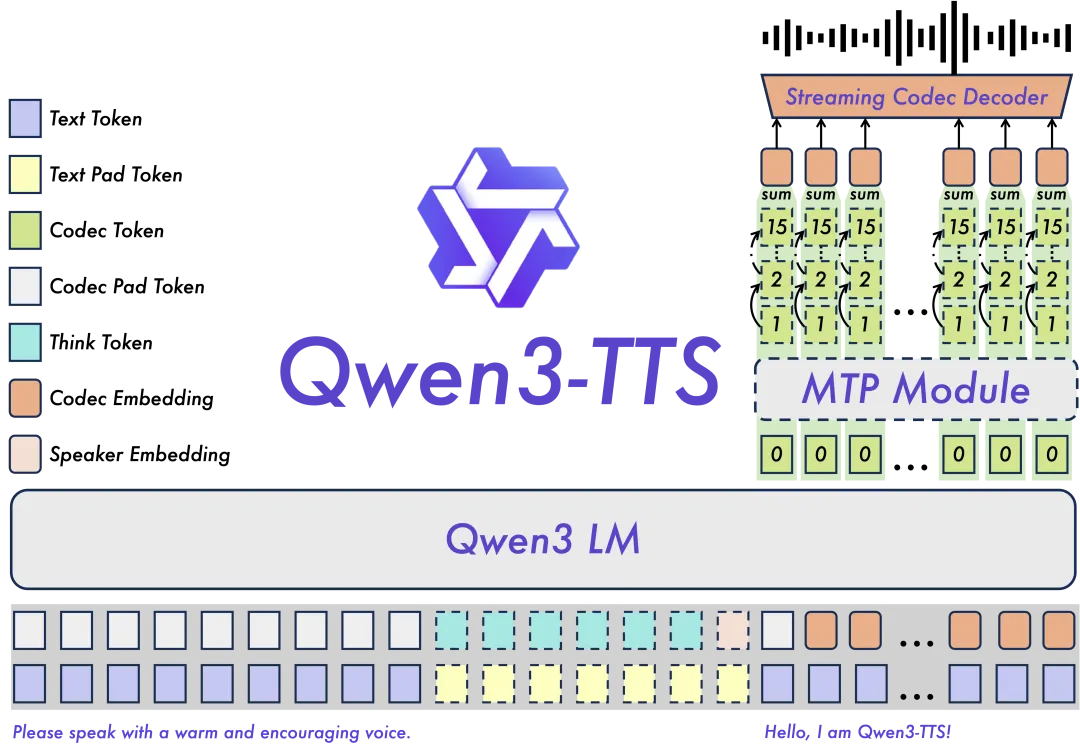
Qwen3 TTS employs a cutting-edge neural network architecture that combines the strengths of Transformers and diffusion models. The model consists of two main components:
- Text Encoder: Responsible for understanding the semantics and prosody of input text
- Acoustic Decoder: Converts encoded information into high-quality audio
This architectural design enables the model to better understand context and generate more natural tonal variations.
2. Hands-On Testing
I deployed Qwen3 TTS locally using an RTX 4090 GPU. Here are my test results:
2.1 Audio Quality
Audio quality is one of the most important metrics for evaluating TTS models. In my testing, Qwen3 TTS delivered impressive results:
- Clarity: Speech is clear without obvious mechanical artifacts
- Naturalness: Tonal variations are natural, approaching human speech
- Emotional Expression: Can adjust tone based on text content
Particularly noteworthy is the model’s ability to correctly handle sentence breaks and pauses in long sentences—a weakness of many TTS models.
2.2 Multilingual Support
Qwen3 TTS supports multiple languages, including:
- Chinese (Mandarin)
- English
- Japanese
- Korean
- And more
In my testing, both Chinese and English performed excellently. Chinese pronunciation was accurate with correct tones, and English pronunciation was authentic without noticeable accent issues.
2.3 Performance
On the RTX 4090, generating a 10-second audio clip takes approximately 2-3 seconds—perfectly acceptable for most use cases. Lower-end GPUs will be slower but still functional.
3. Pros and Cons Analysis
Pros
- Fully Open-Source: Free to use and modify
- Excellent Audio Quality: Comparable to commercial TTS services
- Multilingual Support: Covers major languages
- Local Deployment: Protects data privacy
- Active Community: Continuous updates and improvements
Cons
- Hardware Requirements: GPU needed for optimal experience
- Deployment Complexity: Some technical barrier for non-technical users
- Incomplete Documentation: Some features lack detailed explanations
4. Use Cases
Qwen3 TTS is suitable for the following applications:
- Audiobook Production: Generate high-quality narration audio
- Video Voiceover: Add narration to video content
- Smart Customer Service: Build voice interaction systems
- Accessibility Services: Provide text-to-speech for visually impaired users
- Educational Applications: Language learning and pronunciation demonstrations
Conclusion
Overall, Qwen3 TTS is an excellent open-source speech synthesis model. It excels in audio quality, multilingual support, and flexibility, making it a leader in the open-source TTS space.
If you’re looking for a high-quality TTS solution that can be deployed locally, Qwen3 TTS is definitely worth trying. You can find more information about this project on GitHub.
Disclaimer: This article is based on personal testing experience and does not constitute investment or usage advice. AI technology evolves rapidly—please refer to official sources for the latest information.