Baidu Ernie 5.0 Officially Released: A Quantum Leap with Native Multimodal Architecture and 2.4 Trillion Parameters
Baidu has officially launched Ernie 5.0 (Wenxin 5.0), a native multimodal large language model with a staggering 2.4 trillion parameters. This article provides a deep dive into its unique 'Native Multimodal + MoE' architecture, explores its breakthroughs in cross-modal understanding, code generation, and creative writing, and benchmarks it against top global models like Gemini-2.5 and GPT-5, revealing new heights for Chinese AI technology in 2026.
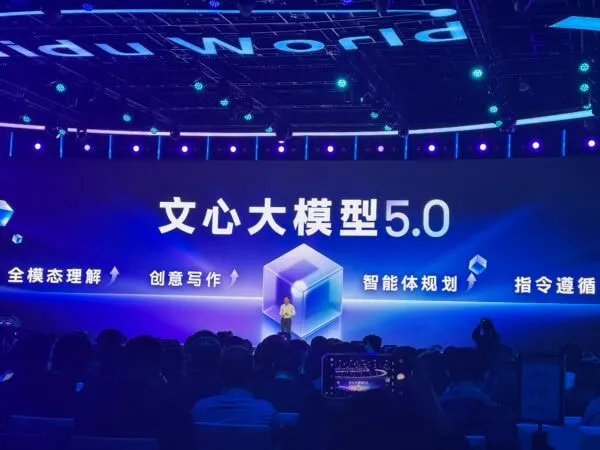
In the global race for artificial intelligence, the iteration speed of models has long surpassed the predictions of Moore’s Law. In January 2026, Baidu dropped another bombshell—the official release of Ernie 5.0 (Wenxin 5.0). This is not just a digital jump in version numbers; it is a complete reconstruction of the underlying architecture.
Bidding farewell to the “patchwork” multimodal solutions of the past, Ernie 5.0 adopts a Native Multimodal unified modeling technology, with a parameter scale breaking through 2.4 trillion. At the Wenxin Moment conference, Wu Tian, Vice President of Baidu Group, demonstrated the astonishing capabilities of this “behemoth” in language understanding, visual generation, coding, and long-term task planning. This article will take you deep into the technical core of Ernie 5.0 and interpret how it redefines the boundaries of AI.
Key Takeaways
- Native Multimodal Architecture: Abandoning traditional “late fusion,” it achieves joint training and inference of text, image, audio, and video within the same auto-regressive framework.
- 2.4 Trillion Parameter MoE: Adopts a massive Mixture-of-Experts (MoE) model. Although the total parameters are staggering, the activation ratio is less than 3%, ensuring efficient inference.
- Top-Tier Performance: In over 40 authoritative benchmarks, its comprehensive capabilities surpass Gemini-2.5-Pro and GPT-5-High, ranking first domestically and eighth globally on the LMArena text leaderboard.
- Agent Evolution: Possesses powerful “Chain of Thought” and “Chain of Action” capabilities, able to replicate APP frontend code solely from video tutorials, demonstrating strong tool invocation and execution skills.
1. Architectural Revolution: From “Stitching” to “Native”
1.1 What is Native Multimodal?
Before Ernie 5.0, most Large Multimodal Models (LMMs) were essentially “Frankenstein monsters”: a vision encoder (like ViT) added to a language model (like LLM), connected by an adapter. This “late fusion” solution has inherent defects—massive information loss between modalities and difficulty in achieving deep semantic alignment.
Ernie 5.0 chose a harder but more potential-filled path: Unified Auto-regressive Architecture.
- Unified Input: Whether pixels, sound waves, or text, all are transformed by the Tokenizer into vectors in the same semantic space.
- Joint Training: In the pre-training phase, the model simultaneously “watches” videos, “listens” to audio, and “reads” articles, truly learning to perceive the world comprehensively like a human.
As Wu Tian introduced: “This allows multimodal features to be fully fused and synergistically optimized under a unified architecture, achieving native full-modal unified understanding and generation.”
1.2 The Way of MoE with 2.4 Trillion Parameters
The parameter scale of Ernie 5.0 reaches an astounding 2.4 trillion. For comparison, GPT-4 is estimated to have around 1.8 trillion parameters. However, how does such a huge model ensure inference speed? The answer lies in MoE (Mixture-of-Experts) technology.
- Ultra-Sparse Activation: Ernie 5.0 contains hundreds of “expert” neural networks internally, but when processing each Token, the system only activates the few experts most adept at the task.
- Activation Rate < 3%: This means that although the model has a huge “brain capacity,” it mobilizes less than 3% of its brain cells when thinking about specific problems. This ensures both a broad knowledge reserve (stored by all experts jointly) and extremely low inference latency and energy consumption.
2. Live Demo: Agents Beyond Imagination
At the conference, Ernie 5.0 demonstrated two impressive capabilities, directly proving its dual breakthroughs in “logical reasoning” and “creative writing.”
2.1 Video Programming: Replicating the “Are You Alive” App
In the demo, staff only input a tutorial video of a blogger making an “Are You Alive” APP. Ernie 5.0 relied on no additional text instructions and directly completed the following steps:
- Video Understanding: Frame-by-frame analysis of video content, identifying the APP’s UI layout, interaction logic, and functional modules.
- Logic Decomposition: Transforming visual information into program design logic.
- Code Generation: Directly outputting runnable frontend code.
This demonstrates the model’s extremely strong cross-modal code generation capability—it is not “translating” code, but “writing” code after “understanding” the requirements.
2.2 Creative Mimicry: Wang Xifeng Writes a Business Plan
In another demo, Ernie 5.0 was asked to simulate the tone of Wang Xifeng (“Phoenix”), a character from “Dream of the Red Chamber,” to write a “Grand View Garden Asset Restructuring Plan.”
- Result: The generated plan not only strictly conformed to modern business rules (such as asset inventory, debt restructuring) logically but also adopted the semi-classical language style of the novel throughout. The tone was sharp and capable, perfectly replicating Wang Xifeng’s shrewd personality. This shows that Ernie 5.0 has reached a very high level in style transfer and contextual understanding.
3. Authoritative Benchmarking: Joining the Global First Tier
Data is the only standard for testing models. According to results from LMArena (Large Model Arena) and over 40 authoritative benchmarks, Ernie 5.0 handed in a dazzling report card.
3.1 Comprehensive Ranking
- LMArena Text Leaderboard: Scored 1460 points, ranking first domestically and eighth globally.
- Competitor Comparison: In language and multimodal understanding capabilities, it surpassed Gemini-2.5-Pro and GPT-5-High (Note: These are comparison data cited from the launch event). This marks that domestic large models are no longer “followers” in core capabilities but have the strength to “wrestle” with top Silicon Valley models.
3.2 Niche Areas
- Image and Video Generation: Comparable to vertical models specializing in visual generation (such as Midjourney v7 or Sora).
- Long Text Processing: Benefiting from a million-token context window, Ernie 5.0 performs particularly well in long-text tasks such as legal contracts and academic papers.
4. Ecological Layout: “Wenxin Tutor” and Industry Implementation
The destination of technology is application. Baidu knows well that large models cannot just live in laboratories.
4.1 Wenxin Tutor Plan
To make the model more “knowledgeable,” Baidu launched the “Wenxin Tutor” plan, absorbing 835 experts from fields such as technology, finance, healthcare, literature, history, and philosophy. These human experts do not write code directly but perform “appreciation and evaluation” and “professional calibration” on the model’s output. This is a high-level RLHF (Reinforcement Learning from Human Feedback), ensuring that Ernie 5.0 is not only smart but also professional and aligned with correct values.
4.2 Full Opening
Currently, Ernie 5.0 is fully live:
- Individual Users: Can experience it for free via the Wenxin APP and Wenxin Yiyan official website.
- Enterprise Developers: Can invoke APIs via the Baidu Qianfan Large Model Platform to customize their own industry models.
Conclusion and Outlook
The release of Ernie 5.0 is a concentrated realization of Baidu’s long-term investment in the AI field. The successful application of native multimodal architecture and MoE technology proves the courage and strength of Chinese AI companies in exploring the “no man’s land” of large models.
Of course, the global AI race is still accelerating. Subsequent versions of GPT-5 and Gemini will also debut successively. But at the beginning of 2026, Ernie 5.0 undoubtedly adds a colorful stroke to this race. For developers, this means we have a more powerful, efficient super tool that understands the Chinese context better.
References: 1. Wenxin 5.0 is Official - WeChat Official Account 2. Baidu Wenxin Yiyan Official Launch Materials (2026.01)
Disclaimer: This article is written based on public release information from January 2026. Some performance comparison data are cited from the official launch event. Actual model performance may vary with version updates.